


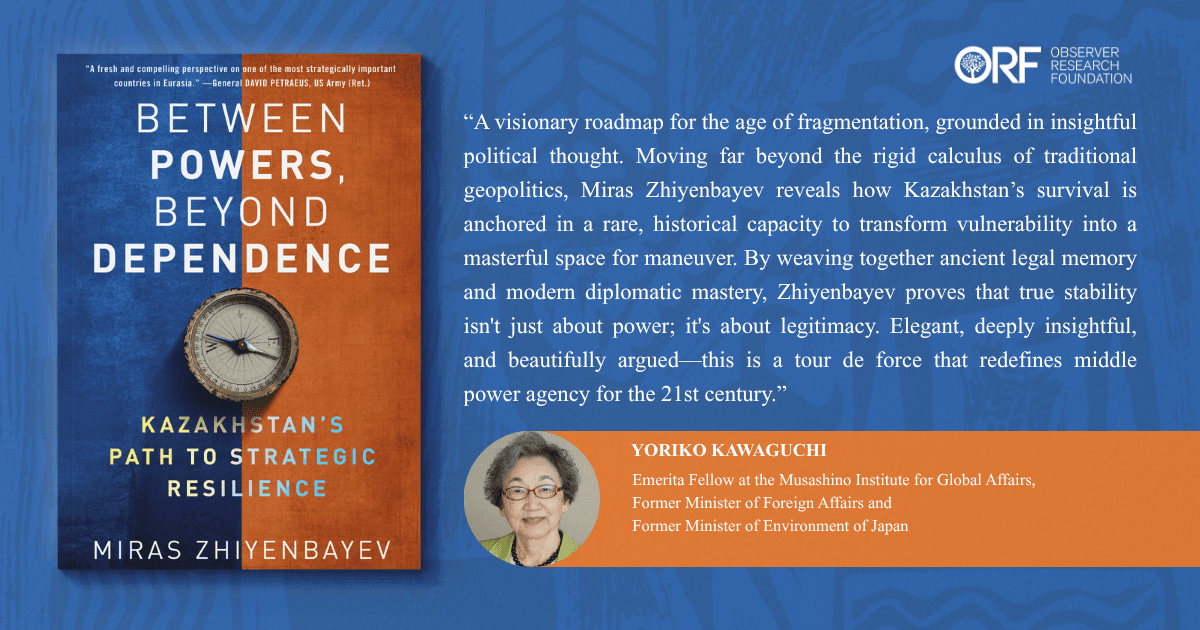


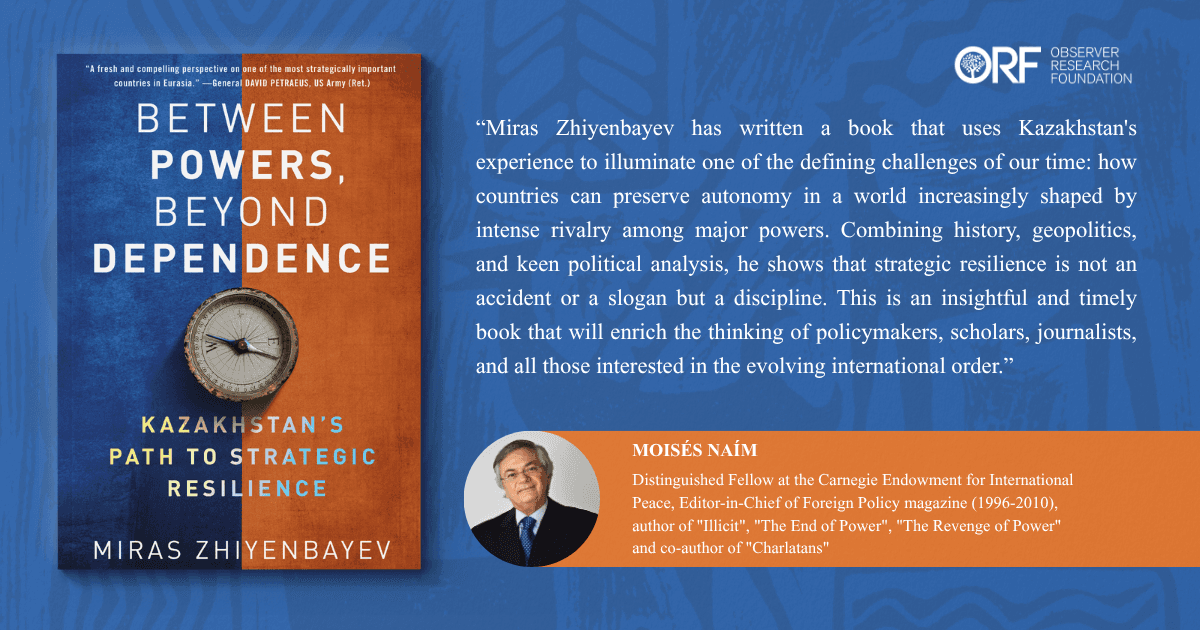


At a time when exposed states are increasingly pressed to choose sides, Between Powers, Beyond Dependence explains why Kazakhstan’s path matters beyond Kazakhstan. It is a book about sovereignty without isolation, openness without naivety, flexibility without surrender, and resilience without grievance. It is, above all, a powerful account of how a nation can remain open to the world without becoming dependent on it.
Kazakhstan is too often explained by where it is on the map—between Russia and China, a corridor between Europe and Asia—and what its geography means: oil, uranium, rare earths; also, pipelines, railways, borders, and great-power pressures. Yet maps can only take us so far. They show the weight of geography, but not the political intelligence nurtured by a nation that has lived with exposure for centuries.
In Between Powers, Beyond Dependence, Miras Zhiyenbayev offers a striking reinterpretation of Kazakhstan’s statecraft. He argues that the country’s foreign policy is not a post-Soviet invention nor a tactical response to the anxieties of the present. Its multivectorism, strategic patience, instinct for mediation, and refusal of rigid dependence are rooted in a much older political repertoire, formed on the steppe and refined through empire, Soviet rule, independence, and the return of great-power rivalry.
Taking the reader from nomadic institutions, customary law, hospitality, collective aid, public voice, and legal memory to contemporary diplomacy, corridors, connectivity, and middle-power agency, this book shows how Kazakhstan has turned vulnerability into room for manoeuvre. It reveals a political tradition that does not seek safety through closure alone, but through disciplined openness, layered belonging, and the careful management of relationships.
Miras Zhiyenbayev
© Copyright 2026